Introduction to Algorithms
Objectives
In this chapter, you will:
- Understand why algorithm analysis is important
- Use "Big-O" to describe execution time
- Understand the "Big-O" execution time of common operations on Python lists and dictionaries
- Understand how the implementation of Python data impacts algorithm analysis
- Understand how to benchmark simple Python programs
Demonstration Labs
Algorithms Demo 1:
File: timing1.py
Prints the running times for problem sizes that double,
using a single loop.
problemSize = 10000000
range_size = 5
print()
print("Count  Problem Size   Seconds")
work = 1
for count in range(range_size): #O(5n)
    start = time.time()         #O(1)
    #the start of the algorithm
    work = 1
    for x in range(problemSize): #O(n)
        work += 1 #O(2) = O(1) because of limits
        work -= 1 #O(2) = O(1) because of limits
    #the end of the algorithm
    elapsed = time.time() - start
    print(count+1     , end='')
    print("%12d%16.3f" % (problemSize, elapsed))
    problemSize *= 2
Expected Output:
| Problem Size | Seconds |
|---|---|
| 10000000 | 3.8 |
| 20000000 | 7.591 |
| 40000000 | 15.352 |
| 80000000 | 30.697 |
| 160000000 | 61.631 |
Algorithms Demo 2
Timing2.py
As another example, consider the following change in tester program's algorithm:
import time

problemSize = 1000

for count in range(5): #O(5n)
    start = time.time() #O(1)
    #start the algorithm
    work = 1
    for j in range(problemSize): # O(n)
        for k in range(problemSize):
            work += 1 #O(2)
            work -= 1 #O(2)
    #end of algorithm
    elapsed = time.time() - start

    print(f'{count+1}  {problemSize} - {elapsed}')
    problemSize *= 2
Expected Output:
| PROBLEM SIZE | SECONDS |
|---|---|
| 1000 | 0.387 |
| 2000 | 1.581 |
| 4000 | 6.463 |
| 8000 | 25.702 |
| 16000 | 102.666 |
Algorithms Demo 3:
File: counting.py
Prints the number of iterations for problem sizes
that double, using a nested loop.
problemSize = 1000
range_size = 5
print("Count  Problem Size     Iterations")

for count in range(range_size):
    number = 0

    work = 1
    for j in range(problemSize):
        for k in range(problemSize):
            number += 1
            work += 1
            work -= 1

    print(count+1   , end="")
    print("%12d%15d" % (problemSize, number))
    problemSize *= 2
**As you can see from the results, the number of iterations is the square of the problem size
Expected Output:
| PROBLEM SIZE | SECONDS |
|---|---|
| 1000 | 1000000 |
| 2000 | 4000000 |
| 4000 | 16000000 |
| 8000 | 64000000 |
| 16000 | 256000000 |
Algorithms Demo 4:
File: countfib.py Prints the number of calls of a recursive Fibonacci function with problem sizes that double.
from collections import Counter

def fib(n, counter):
    #count the number of calls of fib function
    counter[n] += 1
    if n < 3:
        return 1 #base case
    else:
        return fib(n-1, counter) + fib(n-2, counter)

problemSize = 2
for count in range(5):
    counter = Counter()
    #start of the algorithm
    fib(problemSize, counter)
    #end algorithm
    print(f'{problemSize}   {counter}')
    problemSize *= 2
Expected Output:
| PROBLEM SIZE | CALLS |
|---|---|
| 2 | 1 |
| 4 | 5 |
| 8 | 41 |
| 16 | 1973 |
| 32 | 4356617 |
Search Algorithms
Minimum Example Search
def index0fmin(lyst):
    """Returns the index of the minimum item."""
    minIndex = 0
    currentIndex = 1
    while currentIndex =1
        if lyst[currentIndex] < lyst[minIndex]:
            minIdex = currentIndex
        currentIndex += 1
    return minIndex
Sequential Search of List
def sequentialSearch(target, lyst):
    """Returns the position of the target item if found, or -1 otherwise."""
    position = 0
    while position < len(lyst):
        if target == lyst[position]:
            return position
        position += 1
    return -1
Binary Search:
def binarySearch(target, sortedLyst):
    left = 0
    right = len(sortedLyst) - 1
    while left <= right:
        midpoint = (left + right) // 2
        if target == sortedLyst[midpoint]:
            return midpoint
        elif target < sortedLyst[midpoint]:
            right = midpoint - 1
        else:
            left = midpoint + 1
        return -1
Comparing Data Items
class SavingsAccount(object):
    """This class represents a savings account with the owner's nmae, PIN, and balance."""
    def _init_(self, name, pin, balance = 0.0):
        self.name = name
        self.pin = pin
        self.balance = balance

    def _lt_(self, other):
        return self.name < other.name

    # Other methods, including _eq_

>>> s1 = SavingsAccount("Ken", "1000", 0)
>>> s2 = SavingsAccount("Bill", "1001", 30)
>>> s1 < s2
False
>>> s2 < s1
True
>>> s1 > s2
True
>>> s2 > s1
False
>>> s2 == s1
False
>>> s3 = SavingsAccount("Ken", "1000", 0)
>>> s1 == s3
True
>>> s4 = s1
>>> s4 == s1
True
- You can now place the accounts in a list and sort them by name.
Sort Algorithms
Basic Sort Demo 1:
def swap(lyst, i, j):
    """Exchanges the items at positions i and j."""
    # You could say lyst[i], lyst[j] = lyst[j]. lyst[i]
    # but the following code shows what is really going on
    temp = lyst[i]
    lyst[i] = lyst[j]
    lyst[j] = temp
Selection Sort Algorithm
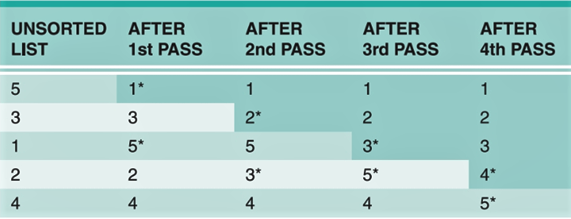
def selectionSort(lyst):
    i =0
    while i < len(lyst) - 1:     # Do n - 1 searches
        minIndex = i             # for the smallest
        j = i + 1
        while j < len(lyst):     # Start a search
            if lyst[j] < lyst[minIndex]:
                minIndex = j
            j += 1
        if minIndex != 1:        # Exchange if needed
            swap(lyst, minIndex, i)
        i += 1
Bubble Sort Algorithms
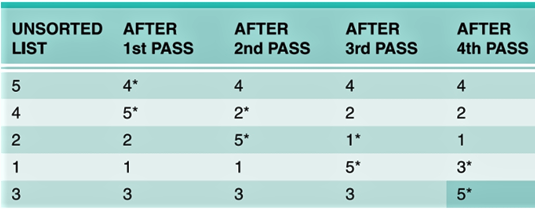
def bubbleSort(lyst):
    n = len(lyst)
    while n > 1:                       # Do n - 1 bubbles
        i = 1                          # Start each bubble
        while i < n:
            if lyst[i] < lyst[i - 1]:  # Exchange if needed
                swap(lyst, i, i - 1)
            i += 1
        n -= 1
Modified Bubble Sort function:
def bubbleSortWithTweak(lyst):
    n = len(lyst)
    while n< 1:
        swapped = False
        i = 1
        while i < n:
            if lyst[i] < lyst[i - 1]:  # Exchane if needed
                swap(lyst, i, i - 1)
                swapped = True
            i += 1
        if not swapped: return         # Return if no swaps
        n -= 1
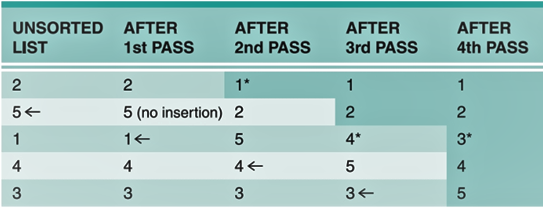
Insertion Sort Algorithms
def insertionSort(lyst):
    i = l
    while i < len(lyst):
        itemToInsert = lsyt[i]
        j = i - 1
        while j >= 0:
            if itemToInsert < lyst[j]:
                lyst[j + 1] = lyst[j]
                j -= 1
            else:
                break
       lyst[j + 1] = itemToInsert
       i += 1
Quick Sort & Merge Sort Algorithms
Quicksort:

Implementation of Quicksort
def quicksort(lyst):
    quicksortHelper(lyst, 0, len(lyst) - 1)

def quicksortHelper(lyst, left, right):
    if left < right:
        pivotLocation = partition(lyst, left, right)
        quicksortHelper(lyst, left, pivotlLocation - 1)
        quicksortHelper(lyst, pivotLocation + 1, right)

def partition(lyst, left, right):
    # Find the pivot and exchange it with the last item
    middle = (left + right) // 2
    pivot = lyst[middle]
    lyst[middle] = lyst[right]
    lyst[right] = pivot
    # Set boundary point to first position
    boundry = left
    # Move items less than pivot to the left
    for index in range(left, right):
        if lyst[index] < pivot:
            swap(lyst, index, boundary)
            boundary += 1
    # Exchange the pivot item and the boundary item
    swap (lyst, right, boundary)
    return boundary

# Earlier definition of the swap function goes here

import random

def main(size = 20, sort = quicksort):
    lyst = []
    for count in range(size):
        lyst.append(random.randint(1, size + 1))
    print(lyst)
    sort(lyst)
    print(lyst)

if _namd_ == "_main_":
    main()
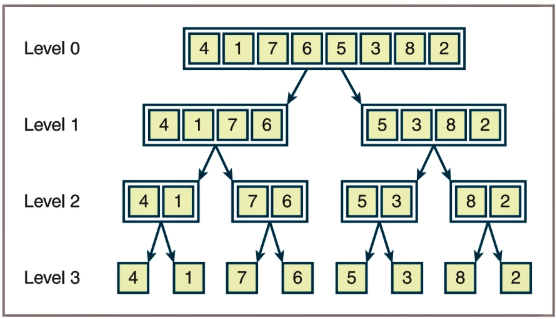
Merge Sort Examples
from arrays import Array

def mergeSort(lyst):
    # lyst     list being sorted
    # copyBuffer temporary space needed during merge
    copyBuffer = Array(len(lyst))
    mergeSortHelper(lyst, copyBuffer, 0, len(lyst) - 1)
from arrays import Array

def mergeSort(lyst):
    # lyst     list being sorted
    # copyBuffer temporary space needed during merge
    copyBuffer = Array(len(lyst))
    mergeSortHelper(lyst, copyBuffer, 0, len(lyst) - 1)
def mergeSortHelper(lyst, copyBuffer, low, high):
    # lyst          list being sorted
    # copyBuffer    temp space needed during merge
    # low, high     bounds of sublist
    # middle        midpoint of sublist
    if low < high:
        middle = (low + high) // 2
        mergeSortHelper(lyst, copyBuffer, low, middle)
        mergeSortHelper(lyst, copyBuffer, middle + 1, high)
        merge(lyst, copyBuffer, low, middle, high)
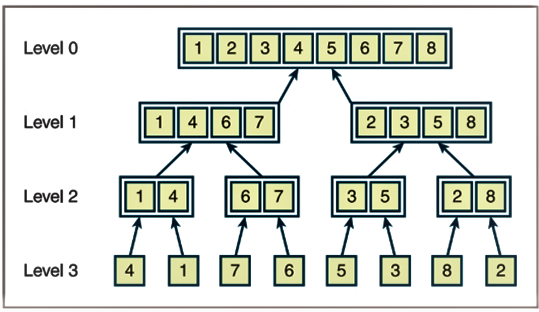
def merge(lyst, copyBuffer, low, middle, high):
    # lyst           list that is being sorted
    # copyBuffer     temp space needed during the merge process
    # low            beginning of first sorted sublist
    # middle         end of first sorted sublist
    # middle + 1     beginning of second sorted sublist
    # high           end of second sorted sublist
    # Initialize     i1 and i2 to the first itend of second sorted sublist
    i1 = low
    i2 = middle + 1
    # Interleave items forom the sublists into the copyBuffer in such a way that order is maintained
    for i in range(low, high +1):
        if i1 > middle:
            copyBuffer[i] = lyst[i2]   # First sublist exhausted
            i2 += 1
        elif i2 > high:
            copyBuffer[i] = lyst[i1]   # Second sublist exhausted
            i1 +=  1
        elif lyst[i1] < lyst[i2]
            copyBuffer[i] = lyst[i1]   # Item in first sublist <
            i1 += 1
        else:
            copyBuffer[i] = lyst[i2]   # Item in second sublist <
            i2 += 1
    for i in range (low, high + 1):    # Copy sorted items back to proper position in lyst
        lyst[i] = copyBuffer[i]        # proper position in lyst